An aerial view of Malaysia's Sipadan island in the tropical waters off the northeast coast of Borneo in this file photo dated May 1, 2000. The World Court on Tuesday ruled in favour of Malaysia in its dispute with Indonesia over two tiny palm-fringed islands-Sipadan and Ligitan—famed for exotic diving.
This description is not far from reality: it might even actually downplay a little bit, as Sipadan is considered one of the five top diving destinations in the world. This small rainforest-covered tropical island rising from a 700 meter abyss in the Celebes Sea is a destination the committed diver cannot miss.
Pulau Sipadan Resort & Tours Sdn Bhd , one of a handful of operators allowed to bring divers into this protected island, Divers will be confortably accommodate at Sipadan-Kapalai Dive Resort (Known best as Kapalai), offers great food and comfortable accommodation in simple, water chalets with attached bathrooms, mini refregerator and power points, with three boat dives a day, unlimited pier diving and not-to-be missed excursions to the nearby very different dive sites around Kapalai and Mabul.
SIPADAN-KAPALAI DIVE RESORT is also equipped with Internet and Satellite Phone.
Sipadan - Kapalai Dive Resort
A few minutes by boat from Sipadan but a full world away it lies the exhilarating Sipadan-Kapalai Dive Resort , sitting on its sturdy stilts on the shallow sandbanks of the Ligitan Reefs. Planned and built in full style as an airy, comfortable, sunny water village with no land in sight, it boats a mile-long sandbank of powdery blindingly white sand where one can suntan at complete leisure.
The resort offers great food, surprisingly roomy and elegant twin-sharing wooden chalets with huge private balconies and attached bathrooms and a couple of miles of walkways for those who like to take their morning jog while looking at thousands of fish just a few inches beneath their feet. Meals are served in the terraced, open central structure, while a big western sundeck allows divers to have an evening drink or an after-dive chat with a background of fabulous tropical sunsets.
Diving around Kapalai is exceedingly easy and shallow but quiet spectacular: the sandy bottom and the spare coral heads host an amazing array of small, often yet-to-be-classified, shamelessly colorful subjects, making the diving here and unforgettable experience for any discerning photographer. The resort offers three dives a day plus, if requested, day trips at Sipadan.
Sipadan - Lakayan Resort
A jewel- like tiny island in the Sulu Sea and hour and a half boat ride's north of Sandakan, Lakayan is soon to be declared part of an immense Marine Protected Area. Unpopulated and covered by think tropical island vegetation on its topside, this peaceful, untouched tittle bit of paradise is ringed by an endless pure white sandy beach, offering simply elegant and exquisite accommodation in a handful of wooden, roomy and perfectly appointed seafront double-occupancy chalets.
Meals are informally served at the central open building, which boasts at amazingly beautiful open-air wooden terrace, the ideal spot for after dinner relaxation and chatting, all the while admiring the dozens of juvenile blacktip sharks swimming leisurely a few feet beneath.
While the ideal destination for who search tranquility and relaxation in a virgin natural setting and for families with children, Lakayan Island is also one of the hottest diving destination on the map today: its dive sites - all just a few minutes away - boast unbelievably colorful macro fauna, fascinating wrecks and, in season from March to May, regular sightings of gigantic and harmless whale sharks, the "dream date " of every diver in the world.

Tioman is the biggest and most impressive island at the east coast. There is a brisk jungle covers a ridge on the west section of the island, which ends at the idyllic location of a beautiful palm fringed beach. Tioman offers a wide range of activities for visitors: snorkeling in crystal clear water, discover the beautiful underwater world when you go diving, or just laze on the beach while you work on that tan. Also, there is a jungle on the island that is just begging to be explored. The dense forest is a habitat for many kinds of flora and fauna.
Tioman was discovered as a holiday destination quite some time ago. It was the setting for the supposedly mythical magical island of Bali Hai from the 1958 Hollywood movie 'South Pacific'. In the 70s the Time magazine selected Tioman as one of the world's most beautiful islands.
Tioman is still rated as one of the world's most beautiful islands. It presents itself as a paradise island in the tropics. But sometimes you have to search for this paradise off the beaten track.
Sample Picture
View
coastline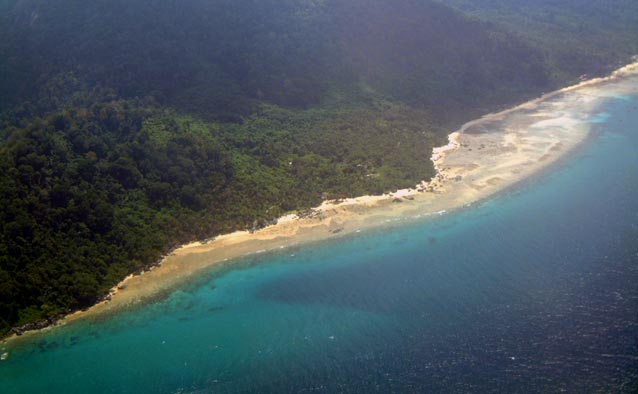

Heavenly

Pulau Aur
Sitting a fair distance, some 80km east of the Mersing jetty,are the islands of Pulau Dayang, Pulau Lang, Pulau Aur and Pulau Pinang *. This cluster of islands is particularly difficult to get to -one reason being that the boats going to and fro are irregular and another being that many of the dive operators seem to have monopolised the islands for 'weekend' SCUBA divers and friends.
But it is not impossible to travel to these islands if time and money is not an issue. Of course there are packages offered by a few live aboards and dive boats that take passengers on a passage to discovery, or you could hire a boat to take you to the island (with a group 10 friends or so to split the cost), or even join in with weekend dive or snorkelling groups organised by the dive operators from Singapore or Malaysia. Do bear in mind that most of the resorts on the islands are owned by these weekend dive operators or have joint-partnerships with the locals which means that often when the weekend crowd returns home, the resorts will close for the week. There are of course a few locally owned resorts at the villages where you can stay. 
resort on Pulau Dayang
If you have the time, you could hop on the weekend dive boats to the islands, stay a week and then hop back onto the next batch of boats heading to the mainland the weekend after.
One can only but wonder if the Aur islands have been reserved specifically for the elite with a lot of money to spend. However, this really shouldn't deter the traveller in a quest for the perfect island to explore, to laze about or to indulge in the culture and hospitality of the local fishermen and their families. Once you're there, you'd know that all that hassle was worth every penny. The relief is that once the weekend crowd has disappeared, you will discover the true beauty of the islands and its waters.
* (Pulau Pinang sounds mighty familiar to you? Don't be misinformed now, it is not the one also commonly known as ' the Pearl of the Orient'. There are a number of islands around Malaysia with the same name, named after the betelnut trees found growing on the islands - pokok pinang, so!)
The battles at Aur 
Pulau Aur has always been a stopover point for fishermen. With a supply of frsh water and plenty of fish in the waters, a few later moved their families to the island. However Aur was never the peaceful island as we see now. The deep dark secrets of the wild days are only beginning to unravel within the historic data collected from salvaged treasures hoisted from sunken Chinese junks, sailboats and old merchants ships found shattered in its watery grave.
In 1803, whilst the Napoleonic War was raging in Europe, a sea battle was brewing in the South China Sea. The Emperor of France and his advisors decided that it was time to infiltrate and dislodge the British from their trade stronghold with the Chinese. With this, France sent a fleet of 5 warships under the command of Admiral Linois to Pulau Aur. By early January 1804, Admiral Linois' fleet had safely parked themselves at Aur.
News that war had recommenced with the French in Europe had not filtered down to the East at that time. Many of the heavily laden ships that had set sail before the war were vulnerable to attacks and the captains were unaware that war had broke out in Europe. The ships lacked accompanying warships to fend off marauders and they were caught off guard. With this advantage, Admiral Linois' fleet successfully intercepted a handful of trading ships along the way. 
Meanwhile, on 31st January 1904 also unaware of the danger, a 30 British-China fleet and a single armed brig left Canton for Pulau Aur. Upon leaving China, Captain Nathaniel Dance who was the Commanding officer,had the foresight to fit 3 of the merchant ships with false gun ports and have them fly the Royal Navy flag.
Admiral Linois laid in wait for the fleet from China to arrive in hope of a surprise attack which would put the French in a favourable position to confiscate the lucrative cargo. When the China-British fleet sailed into Aur on February 14th, Admiral Linois was himself taken by surprise by the three 'warships' accompanying the fleet. Uncertain of the strength of the British warships, the Admiral went ahead with couple of disastrous attacks and eventually retreated to Batavia (Jakarta) in defeat. Captain Nathaniel Dance sailed back to England and was showered with rewards especially from the insurers of the fleet and rightly so as the cargoes had at that time an estimated value of 8 million pounds! Emperor Bonaparte suffered an embarrassing defeat and just to add salt to his wound, it was his British sources that first broke the news to him. 
In the 19th Century, Aur harboured a thriving population of about 1,400 inhabitants consisting of fishermen, traders and slaves. The islands were an ideal location for pirates to run their business of pillaging, ravaging, slave trading and even sinking a great number of boats during fierce raids with foreign boats enroute to Indonesia or to Thailand and beyond.
Today, not much of the tumultuous history can be traced from above the shoreline. Beneath, there are several wrecks that has been discovered and partly recovered but beyond the reaches of recreational divers. They are rumoured to contain treasures and wrecks beyond our imagination. Perhaps they should left in peace in these graves together with their masters from a long forgotten era of great sea voyages.

The best part about this popular Island destination is the range of accomodation. You could choose from an A type hut on the beach to the luxurious and exclusive Pangkor Laut Resort. Whichever you may choose, sandy beaches, clear waters and refreshing breezes await all visitors to this well-known resort.
Just 90km south-west of Ipoh, this fun island getaway is laden with modern facilities and water sports activities. The eastern shores are peppered with fishing villages and many visitors come to buy their year's supply of "keropok" ( fish or prawn crackers) here. 
If you want a change from watersports, hire a bike and go round the island. The road is hilly at some parts, but you will be able to explore places like the old Dutch Fort, located in Teluk Gedong or the Batu Bersurat ("Inscribed Stone") close by.
How to get there
Access Pangkor Island by sea or air. Take a ferry from the Lumut Ferry Terminal. The boat trip should take 40 minutes. If you are flying, the airport is located at Teluk Dalam.

Scuba Dynamics
No 8 & 10, Jalan 24/70A
Desa Sri Hartamas
50480 Kuala Lumpur
(03) 2300 9060
Fax: 2300 9070
E-mail: info@scubadynamics.com.my
Website: www.scubadynamics.com.my
Scuba Dynamics organises trips to Pulau Aur and other dive sites in Malaysia.
AAAH, the search for the perfect dive site never ends. After hearing tales of a rarely visited Malaysian island, where the water is blue and visibility averages 30m, I readily went along with Henry Batzer of Scuba Dynamics to Pulau Aur.
This was my first time diving off Pulau Aur, having missed the opportunity many times, and it was also my first experience diving with Batzer.
I had been introduced to Scuba Dynamics by one of my diving buddies, who had regaled me with tales of Batzer’s impeccable track record and reputation. And since the guy actually managed to teach my friends to dive, I reckoned he had some serious skill! As it turned out, Batzer was indeed a consummate professional, and my only grouse was that I didn’t get to dive with him more.
Now, although Pulau Aur is a Malaysian island, you wouldn’t have guessed it from the many Singaporeans who come a-calling. Typically, after leaving work on Friday, they depart for Mersing, Johor, whereupon they take a boat at midnight, arriving at 4.30am. They then proceed to log-in six dives before leaving the island just after lunch on Sunday!
If the weekends are hectic, the island is practically yours on weekdays. Amenities are pretty basic. The resort on the best beach has the worst food and the one with the best food has the worst beach. The one with no beach is well known for its nightlife. All have Astro, but electricity to the rooms is limited, and there is no hot running water. However, the diving is good.
To get to Pulau Aur, 70km off Mersing, you can take a boat from the Mersing jetty (the same one that takes you to Pulau Tioman) or Sedilli fishing port. It’s a slow boat ride over some four hours, although some resorts have started using speed boats that cut travel time by half.
Pulau Aur, together with the smaller isles of Pulau Dayang, Pulau Lang and Pulau Pemanggil, make up one half of the Johor Marine Park. Both Dayang and Aur have deep clear water and healthy corals.
Accommodation is available only on these two islands.
The best time to visit Pulau Aur for diving is between April and October, when the sea is calmer and visibility is at its best.
Dive sites
There are many dive sites in the area. Crocodile Rock at 10m is a favourite night dive spot. Teluk Teluran used to be the watery home of Smit Lloyd 19 , a ship which ran aground in 1981. Not much is left today as most of the wreck had been salvaged, but the site is interesting for its large undulating corals, which are home to various octopus, lobsters, crabs and moral eels.
The Garden, also known as the Secret Garden, is a shallow dive site at 15m and has abundant fish and coral life. It’s a good site for new divers and underwater photography. To check out a Ming Dynasty wreck (or so some claim), go to Teluk Mariam. To get to it, do a shore dive from the southern side of the bay towards the jetty.
At Teluk Sebukang, slow finning at around 10m will yield the good stuff. March to April brings out an amazing variety of nudibranches, and you can find garden eels deeper down at around 30m. Robert’s Point located at the northern tip of Pulau Lang has a small but interesting patch of coral with immense variety. Dusk dives are best as the corals here teem with feeding fish. A huge 2m long, moray eel about 18cm in diameter has been spotted here, so look out for it. You might also bump into green turtles, eagle rays and schools of bumphead parrotfish.
Rayner’s Rock is a popular dive site with advanced divers. Here, pelagics can be found on the seaward side of the rock whilst a large variety of soft corals can be found in the valley between the two rocks that break the surface.
Different levels offer different things. Napoleon wrasses, up to 90cm long, have been spotted here and grey tip reef sharks are often sighted between Rayner’s Rock and Teluk Jawa. Whale sharks and Manta rays, too, have been glimpsed.
Pulau Pinang is a barren rock with steep slopes, making it an ideal spot for some wall diving. The sea floor goes down 60m, so keep an eye on your depth gauge. Things to see here include snappers, moral eels, spotted rays and groupers. Turtles and sharks are not uncommon, and if you’re lucky, you may come across giant sea fans. This spot is a good place to do a drift dive if the currents are running.
The Pinnacles is a group of three underwater rocks with the plateau of the centre pinnacle at 18m deep. Schools of batfish and barracuda have also been sighted. Strong currents are common, so plan your dive for slack tides. The variety is quite amazing, so it’s no wonder the divers down south keep coming back.
Getting there
From Kuala Lumpur, head south on the North-South Expressway heading towards Singapore. Take the turn-off to Air Hitam. From here, drive towards Kluang, then towards Kahang town. From there, just follow the signs to Mersing.
Another route on the North-South Expressway is to take the Senawang turn-off and head towards Tanjung Gemuk, before making south again on the coastal road to Mersing.
Either way, the trip takes five to six hours and cuts through some deserted countryside, so make sure your tank is full and your car is in decent condition.
Places to stay
Friendly Waters Chalet
(02) 447 2108
www.friendlywaters.com.sg
Aur Samudera Holidays
(07) 799 4217
Blue Water Resort
(07) 799 4072
Atlantis Bay Resort
(011) 770 279
Aur Holiday Resort
(07) 799 4072
Telok Brai Chalet
(07) 799 4870
Mahmood’s Chalet
(07) 799 4217